

Why Most Travel Businesses Mislabel Themselves
If you run a travel business, you’ve probably faced this moment: a supplier asks whether you’re a tour operator or a travel agent, a client assumes you do both, and even your own team isn’t sure how to explain it. This confusion isn’t just semantic – it affects contracts, responsibilities, workflows, and how your business actually operates.
In today’s environment, where bookings, fulfillment, and after-sales are increasingly system-driven, the way you define your role is closely tied to how you run your operations using travel agency software. Understanding the real difference between a tour operator and a travel agent isn’t about labels – it’s about clarity.
This blog breaks down that difference from the perspective of a travel agency owner, not a textbook.
Key Takeaways
- Travel agents sell and service; tour operators create and package
- The difference lies in responsibility, control, and inventory ownership
- Many modern agencies operate as hybrids
- Clear role understanding reduces confusion with suppliers and clients
- The right platform can support both models seamlessly
Why the Difference Between Tour Operator and Travel Agent Still Matters
The distinction matters because the two roles carry very different responsibilities in how travel is structured, sold, and delivered. Travel agents primarily act as intermediaries, helping customers select and book travel services offered by airlines, hotels, and other suppliers. Tour operators, by contrast, take on a more direct role by combining multiple travel components into a single product and standing behind its delivery.
Industry Snapshot: The global travel agency industry’s revenue is estimated at over $355 billion as of early 2025, while the tour operator industry alone totaled over £17 billion in 2024. Condor Ferries
From a regulatory and industry standpoint, the difference is defined by who organizes the travel product and who is responsible for its performance. In package travel frameworks used across major travel markets, tour operators are treated as organizers of travel services, while travel agents function as retailers or intermediaries acting on behalf of those organizers.
This distinction influences how businesses manage risk, communicate with customers, structure supplier relationships, and handle issues when travel plans change. Clarity around these roles is essential for setting correct expectations and operating with confidence.
What a Travel Agent Really Does in Practice
A travel agent’s core role is to sell, service, and support travel bookings on behalf of suppliers. This includes flights, hotels, transfers, tours, and sometimes pre-built packages.
In practice, modern travel agents:
- Search and compare inventory through consolidators and APIs
- Handle bookings, changes, cancellations, and customer support
- Earn through commissions, service fees, or mark-ups
- Use a b2c booking engine for retail customers
- Rely on corporate travel booking software when managing business clients with approvals and policies
Quick Stat: Leisure travel remains the dominant segment, accounting for 65% of agency sales, with high-end experiences, cruises, and tours fueling growth.
Travel agents don’t usually own inventory. Instead, they focus on distribution, customer experience, and operational efficiency. This is why many agencies invest in software for travel agents that simplifies booking management, documentation, and service workflows.
What a Tour Operator Actually Does (Beyond Selling Tours)
Tour operators operate one step closer to the product. Instead of reselling supplier inventory, they create travel experiences by contracting hotels, transportation, guides, and activities into a single package.
In real terms, a tour operator:
- Contracts and manages inventory
- Sets pricing and package structure
- Takes responsibility for the delivered experience
- Sells directly to travellers or through agents
- Uses a b2b travel portal to distribute packages to partner agencies
Market Growth: The overall tours and activities segment is projected to grow to $183 billion globally – a clear signal that packaged, experience-led travel is on the rise. Accessdevelopment
Unlike agents, tour operators bear more responsibility if something goes wrong because they control how the package is designed and delivered. This requires tighter coordination, inventory visibility, and structured operations.
If you’re exploring how the tour operator model translates into better bookings and smoother customer experiences, here’s a detailed guide: How tour operator software can get you more bookings, enhance customer experience, and skyrocket your revenue growth
Tour Operator vs Travel Agent – The Real Differences
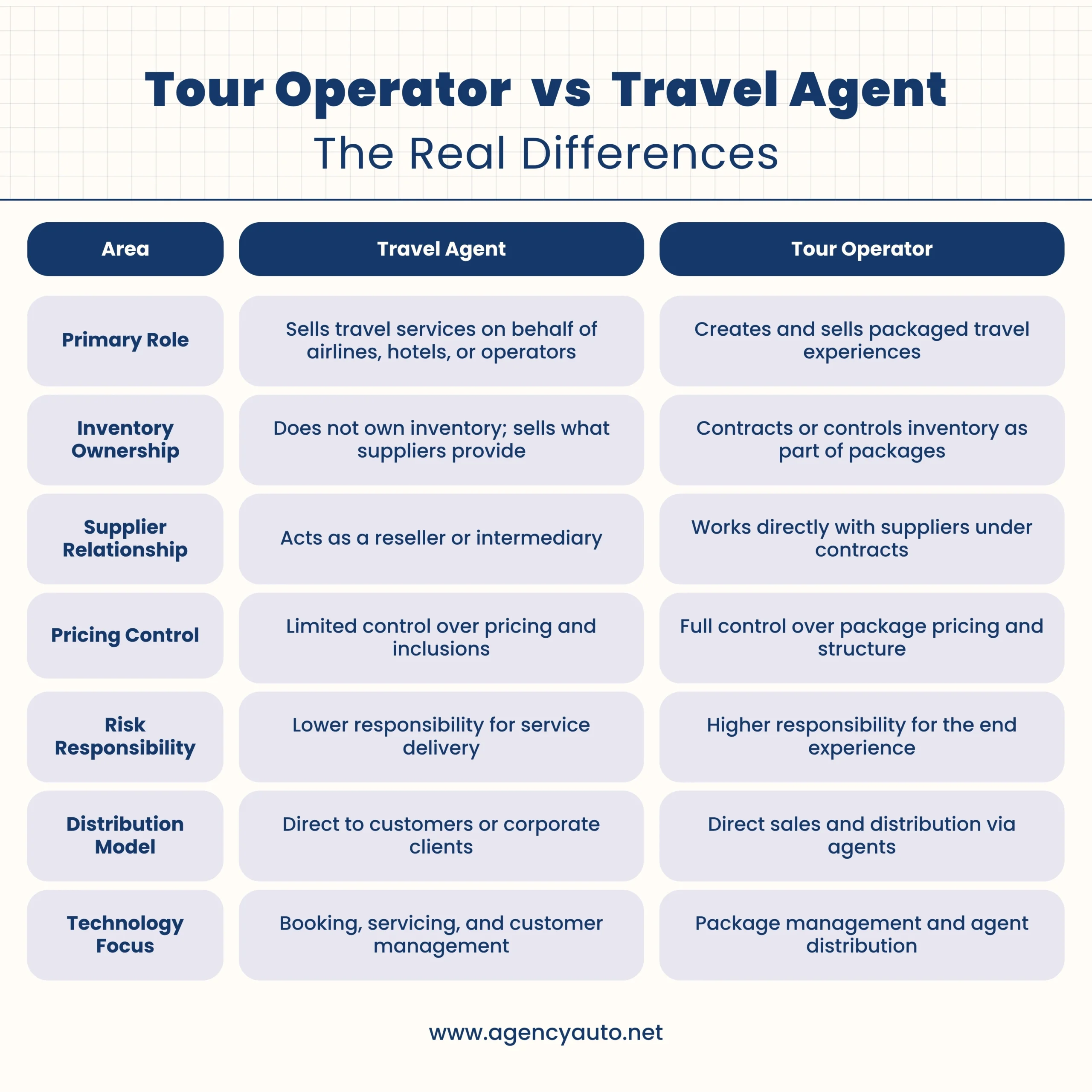
Area | Travel Agent | Tour Operator |
Primary Role | Sells travel services on behalf of airlines, hotels, or operators | Creates and sells packaged travel experiences |
Inventory Ownership | Does not own inventory; sells what suppliers provide | Contracts or controls inventory as part of packages |
Supplier Relationship | Acts as a reseller or intermediary | Works directly with suppliers under contracts |
Pricing Control | Limited control over pricing and inclusions | Full control over package pricing and structure |
Risk Responsibility | Lower responsibility for service delivery | Higher responsibility for the end experience |
Distribution Model | Direct to customers or corporate clients | Direct sales and distribution via agents |
Technology Focus | Booking, servicing, and customer management | Package management and agent distribution |
This comparison highlights why many businesses struggle to classify themselves – especially those operating somewhere in between.
What Is the Role of AgencyAuto for Both Models?
Today, many travel businesses don’t fit neatly into one category. An agency may sell flights like a travel agent while also creating custom packages like a tour operator. This hybrid reality is common – and it’s where the right platform makes a difference.
For a deeper look at why operational systems matter for tour operators, you can read: Why tour operators require back-office software
AgencyAuto is designed to support both travel agents and tour operators without forcing a label. It enables agencies to:
- Manage bookings from multiple suppliers
- Distribute packages or inventory to partners
- Coordinate agents, sub-agents, and customers in one system
- Maintain clarity across bookings, documentation, and fulfillment
Rather than defining what type of business you should be, AgencyAuto adapts to how your business actually works.
Conclusion
The real question isn’t whether you’re a tour operator or a travel agent – it’s whether your operations reflect what you promise to customers and partners. Understanding the difference brings clarity, confidence, and consistency to how you run your business.
Platforms like AgencyAuto exist to support that clarity, helping travel businesses operate smoothly regardless of the model they follow.
Frequently Asked Questions
- 1. Can a travel agent also sell tour packages?
Yes. Many travel agents sell packages created by tour operators or build custom itineraries without owning inventory.
- 2. Does a tour operator always need to own inventory?
Not necessarily, but tour operators typically contract and control inventory, even if they don’t own assets directly.
- 3. Can one business act as both a travel agent and a tour operator?
Yes. Many agencies operate as hybrids, depending on the product and customer segment.
- 4. Do travel agents and tour operators need different systems?
Their needs differ, but modern platforms can support both roles within one ecosystem.
- 5. Who holds responsibility if something goes wrong during a trip?
Usually the tour operator, since they create and package the travel product.
- 6. Is one model more complex to manage than the other?
Tour operators generally manage more complexity due to inventory control and responsibility, while agents focus more on service and coordination.